 Ketchikan City Guide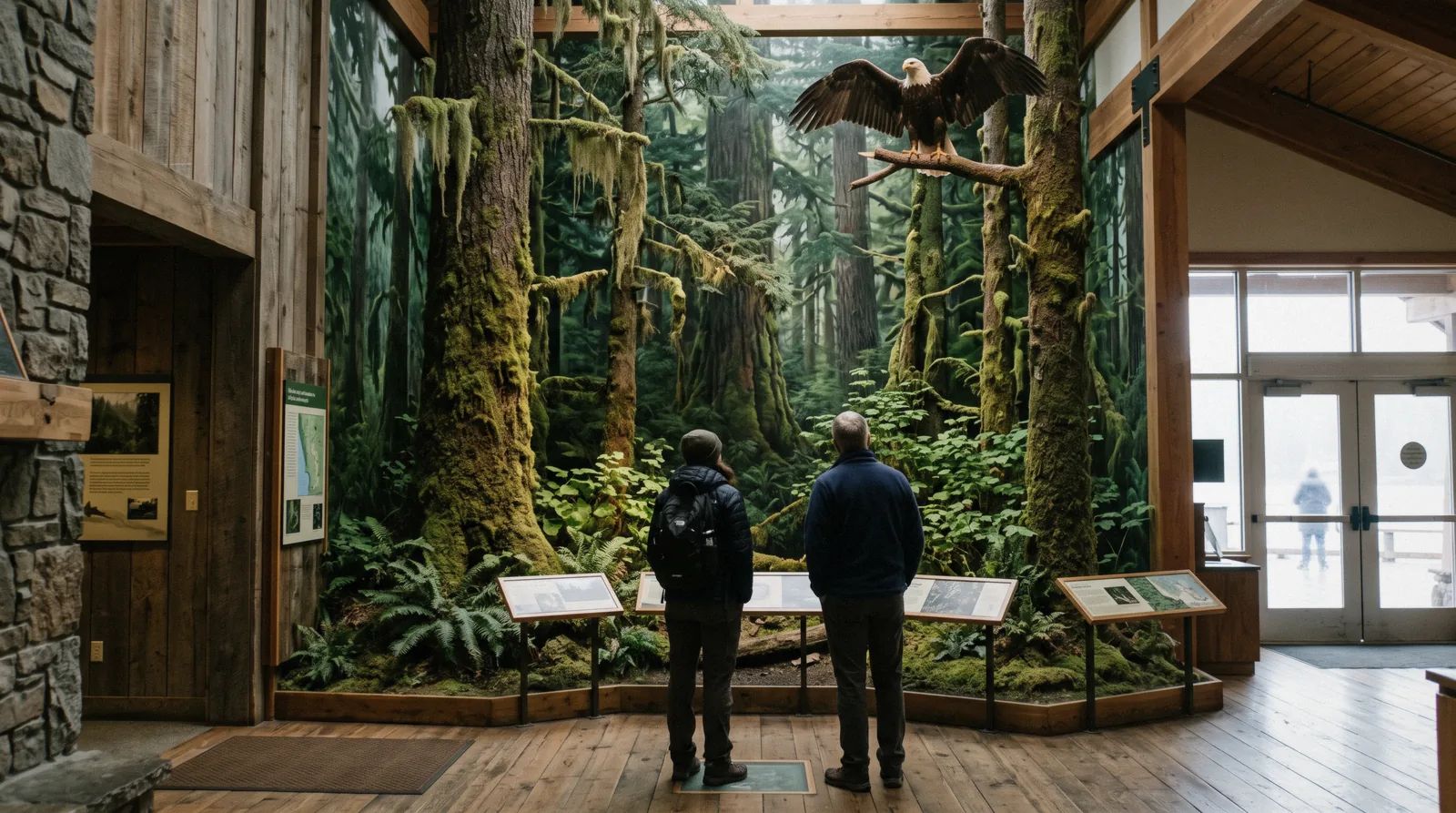
Southeast Alaska Discovery Center
The Southeast Alaska Discovery Center is the US Forest Service's visitor center at 50 Main Street, one block from the cruise berths in downtown Ketchikan. It is the only attraction on this site run by a federal land agency rather than a city, a tribe or a private operator. Two exhibit floors, a large theater and a live underwater salmon camera sit behind a $5 door in season. This page prints what the official pages say, including where they disagree. For the wider forest it introduces, see Tongass National Forest. The town all of this sits in is the Ketchikan guide it introduces.
Quick answer What the downtown USFS visitor center costs, when it opens and what is inside.
The Southeast Alaska Discovery Center charges $5.00 per person from May through September, with children 15 and under free with an adult. From October through April admission is free. Inside are more than 20,000 square feet of exhibits across four halls, a 200-seat theater and a live underwater camera on spawning salmon in Ketchikan Creek. It sits at 50 Main Street, an easy walk from the cruise docks. Hours are the one weak spot, because two official Forest Service pages publish different times, so check both before you plan a visit. Pair it with Creek Street or use it to orient before a rainforest walk.
Key takeaways
- Admission is $5.00 per person in season and free the rest of the year, per the Forest Service fees page.
- Two official pages disagree on opening times, so read our hours breakdown before you go.
- The Elizabeth Peratrovich theater film is the fastest introduction to the Tongass National Forest in town.
- The center works well as a rain-day anchor between the Totem Heritage Center and the waterfront.
Key facts
Opening hours
| Daily, May to September | 09:00–17:00 |
|---|
Admission
- Adult
- $5 per person, May to September
- Reduced
- $15 local season pass covering the holder plus two others
- Free
- Free October to April, and children 15 and under free with an adult all year
Planning it
- Time needed
- Not stated by the Forest Service. Our routing: one hour
- Book ahead
- Optional — walk-up usually fine
- Address
- 50 Main Street, Ketchikan, AK 99901 (per the USFS fees page); a separate USFS office listing gives 648 Mission Street, Suite 110, Federal Building, Ketchikan — both addresses are cited on official USF
This is the clearest fee on the whole site: $5 in season, nothing at all from October to April, and children 15 and under free with an adult. The Forest Service row is the centre itself. The tour rows are what people book instead when the weather is good.
It is $5 and indoors, which on a wet ship day makes it the highest-value hour in Ketchikan.
| Option | Price | Includes | Cancel | Book |
|---|---|---|---|---|
| Walk in yourselfAnyone. This is the cheapest indoor hour in town and it is free half the year. | $5 per person May to September, free October to April | Four exhibit halls, the theater, the salmon camera | Nothing to cancel | Official site |
| Alaska Rainforest Sanctuary and Totem Park WalkAnyone who wants the rainforest outdoors after seeing it explained indoors. | From $110 | 165 minutes, boardwalk through a private preserve | Free up to 24 hours before | Check Availability |
| Totem Pole, Wildlife & City Trolley TourA call that would rather spend the hour on poles than on exhibits. | From $85 | 130 minutes, the totem parks and the town | Free up to 24 hours before | Check Availability |
Two Forest Service pages give different opening hours, one 9:00am to 5:00pm and the other 8:00am to 4:00pm. We print both and name the pages rather than pick one. A $15 local season pass covers the holder plus two others.
What people book after an hour indoors
Four listings that put the Tongass in front of you rather than behind glass. Prices, ratings and durations are the platform’s own figures.
 from $110
Free cancellation
from $110
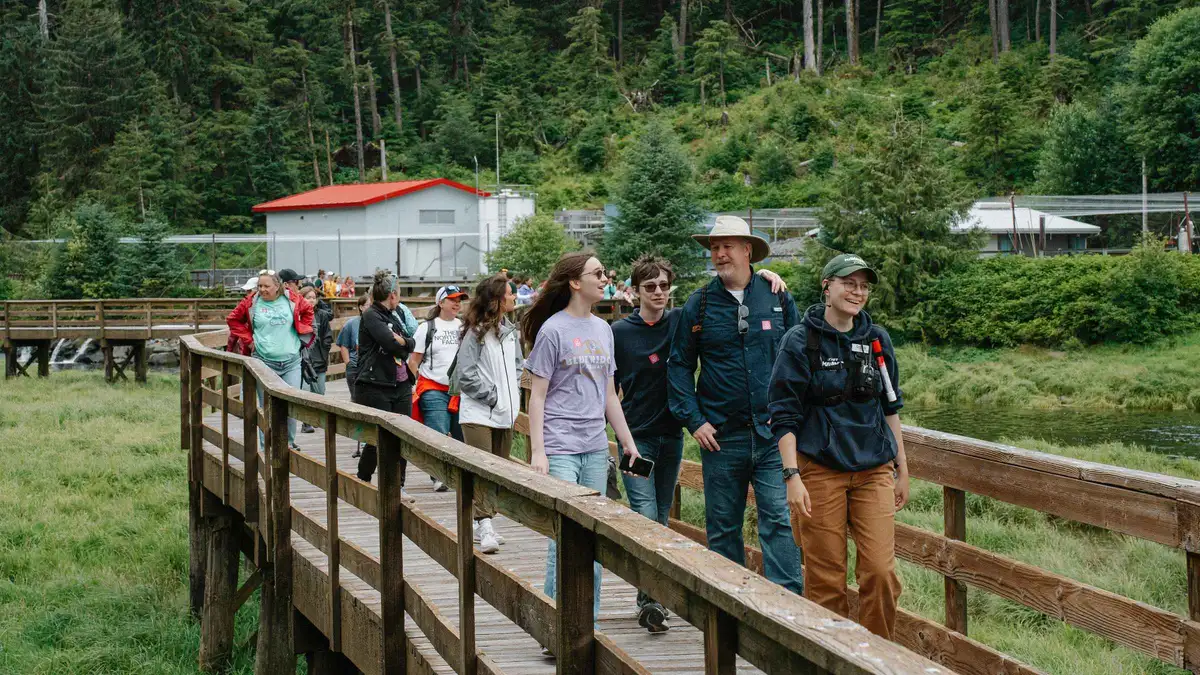
Free cancellation Ketchikan: Alaska Rainforest Sanctuary and Totem Park Walk
A naturalist guide leads a walk through a private 40-acre rainforest reserve past an elevated boardwalk, a historic sawmill and a totem park, watching for eagles, bears and seals along Eagle Creek. Paced gently, so it suits most fitness levels rather than serious hikers.
Check Availability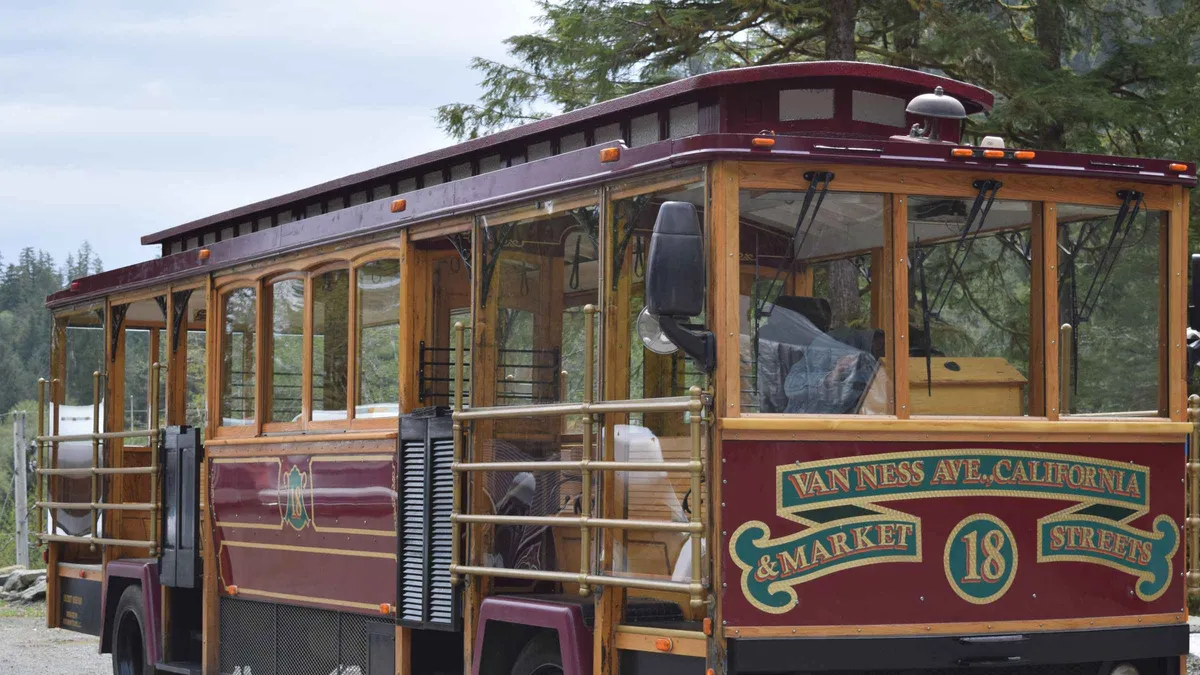 from $85
Free cancellation
from $85
Free cancellation Ketchikan: Totem Pole, Wildlife & City Trolley Tour
An open-sided San Francisco style trolley tours Saxman Native Village's carved totem poles and carving shed, then continues to Herring Cove for a chance at eagles, seals and bears. A shorter option for travelers who mainly want the totem poles and a quick wildlife stop.
Check Availability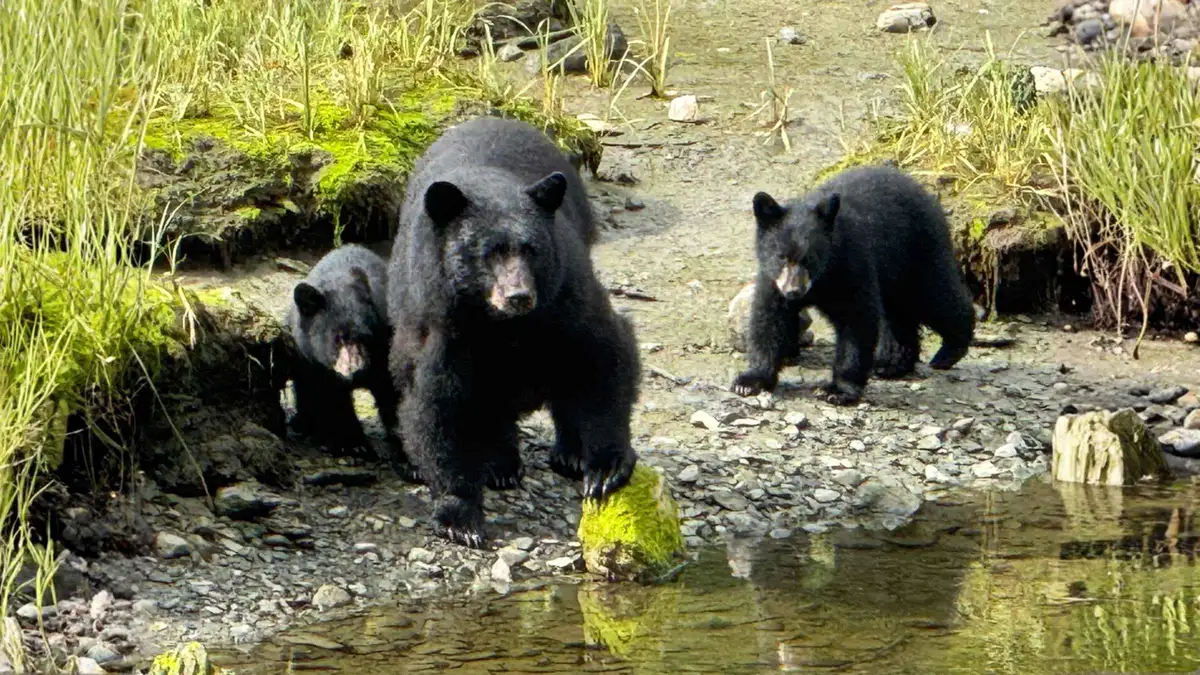 from $128.52
Free cancellation
from $128.52
Free cancellation Premium Rainforest Experience in Ketchikan
A van carries a small group, typically eight to ten people, into the Tongass National Forest to look for bears, eagles and salmon near waterfalls and spawning streams. Riders also get a digital port guide and texting support, useful for anyone new to Ketchikan.
Check Availability from $84
Free cancellation
from $84
Free cancellation Ketchikan: Alaska Native Cultural and Scenic Shore Excursion
A Native-guided van tour run by Clan House Tours stops at four wildlife viewpoints and Totem Bight State Historical Park to cover Haida, Tlingit and Tsimshian history and craft. Fits travelers who want cultural context alongside a chance at spotting bears, salmon and eagles.
Check AvailabilityPrices, ratings and details are the platform's own. dollar figures are the listed prices — the platform bills in your account's currency.
What the Southeast Alaska Discovery Center is
Most attractions in Ketchikan show you one thing. The Southeast Alaska Discovery Center tries to hand you the whole region in one building. It is the US Forest Service's flagship visitor center for southeast Alaska, opened in 1995 as an Alaska Public Lands Information Center, and it is the only place in this guide run by a federal agency rather than a city, a tribe or a tour company.
The building holds more than 20,000 square feet of exhibits across four halls, plus a 200-seat theater named for Elizabeth Peratrovich, the Tlingit civil-rights leader behind Alaska's 1945 Anti-Discrimination Act. It was designed by Jones & Jones Architects working with Indigenous architect Johnpaul Jones, which shows in the way the halls are framed around forest, water and Native traditions rather than glass cases of taxidermy.
Practically, it serves three audiences at once. Cruise visitors use it as a paid, weatherproof introduction to the Tongass before committing to a full-day excursion. Independent travelers use the information desks to plan Forest Service land, cabins and trails. Locals buy a $15 season pass that covers the pass-holder plus two others for unlimited entrance from May through September.
It also differs from the other downtown stops in pace. There is no show timetable, no guide and no boat. You walk in, read and watch at your own speed, and the whole thing is one block from the ship. Compare that with the Totem Heritage Center, which goes deep on one subject, or the Lumberjack Show, which books you into a fixed time.
What you actually see inside
You enter from Main Street into a tall lobby that doubles as the Forest Service information point. Ranger staff answer questions about the Tongass, trails, cabins and permits, so it is worth asking what is running that day before you start the exhibits.
The exhibit halls follow a deliberate order. The first hall puts you in the rainforest itself, with full-scale trees and the light and sound of a coastal stand of spruce and hemlock. The next moves to the water, covering salmon, the fishing economy and the tides that shape everything here. A third hall is devoted to Alaska Native cultures of the region, including Tlingit and Haida life, carving traditions and the relationships between people and the forest. A fourth covers the modern working forest and public lands. Together the four halls run to more than 20,000 square feet, and most of it is readable rather than tactile, which matters if you are traveling with children.
Two stops deserve their own time. The first is the Elizabeth Peratrovich theater, a 200-seat auditorium where the Forest Service screens its large-format film about the region. The film is the single best 20-ish minutes of orientation available in town, and it earns the center its place even for visitors who skip every other exhibit. The second is the live underwater camera trained on Ketchikan Creek. During the salmon runs it broadcasts spawning fish from the creek itself, so you can watch gravel-bottomed footage of Chinook and coho, then walk a few blocks to Creek Street and see the same water from the bridges above.
Note what is not published. The Forest Service pages do not describe individual exhibit pieces in detail, so treat the hall descriptions as the promise and the visit as the confirmation.
Hours, prices and the season
The price is straightforward. Admission is $5.00 per person from May through September, and children 15 and under enter free with an adult. From October through April admission is free. A local season pass costs $15 and covers the pass-holder plus two others for unlimited entrance May through September. America the Beautiful Interagency Passes are accepted. All of this comes from the Forest Service fees and passes page for the center.
The hours are where this page has to be honest with you. Two official USFS pages disagree. The fees and passes page states May 1 through September 30, seven days a week, 9:00am to 5:00pm, closed federal holidays. The separate recreation page for the same center states May 1 through September 30, daily 8:00am to 4:00pm, and October through April on Fridays and Saturdays only, 8:00am to 4:00pm. These have not been reconciled. Before you build a morning or an off-season plan around either figure, check the live Forest Service pages or call, because the correct window may be narrower than you assume.
The closed days also differ by source. The fees page names federal holidays as closures in season. The recreation page implies a much reduced off-season schedule of two days a week. If you are in town in winter, do not assume a weekday visit works.
Other practical gaps are equally plain. The official pages do not publish a recommended visit length, and no ADA-specific accessibility detail appears on the fees page, only a general USDA accessibility statement.
For comparison, the city-run Totem Heritage Center publishes its own distinct hours and a lower reported adult price, so the two centers are not interchangeable on a schedule.
Getting there from the cruise docks
This is one of the easiest attractions in Ketchikan to reach. The center sits at 50 Main Street, in the downtown core at the base of the hill, and the four Panamax cruise berths run south to north along the same downtown waterfront. From any of Berths I through IV you can walk it in a few minutes without crossing anything more demanding than a street or two. No shuttle, taxi or bus is needed.
If you are arriving at Ward Cove instead, the picture changes. Ward Cove is about 7 miles north of downtown, and the complimentary shuttle to Berth IV takes about 20 minutes each way. Budget the full ride plus buffer in each direction before you add the center to a Ward Cove day, and check the last shuttle departure in the daily ship schedule so you do not strand yourself.
A small address footnote, because signs and listings disagree. The USFS fees page gives 50 Main Street. A separate USFS office listing gives 648 Mission Street, Suite 110, in the Federal Building. Both addresses appear on official USFS pages and the discrepancy is unresolved. The visitor-center entrance visitors use is the Main Street one.
The free downtown shuttle zone runs from roughly Bryant Street to the Coast Guard Base in summer and on cruise days, so if you have walked far already you can ride part of the way back. The paid Borough bus is unnecessary here. Of the three options, on foot is the one that actually works, and it works from every downtown berth.
One line from the official page, verbatim, because it is the kind of detail nobody else prints: No restrooms on-site. A general USDA accessibility statement is referenced but no ADA-specific detail is published on the page.
Discovery Center map: 50 Main Street, by the berths
The centre is minutes from the downtown berths. The other pins are the nearest places on this site.
Do and don't at the Discovery Center
Small moves that change the visit, all of them doable the same day.
Do
- Watch the film in the Elizabeth Peratrovich theater before the exhibits, then let the halls answer the questions it raises.
- Check the live underwater salmon camera, then walk to Creek Street to see the same creek from the bridges.
- Ask the Forest Service desks about Tongass National Forest trails and cabins if you are planning beyond the docks.
- Carry an America the Beautiful pass if you hold one, since it is accepted at the door.
Don't
- Don't trust a single hours figure, because two official pages disagree. Verify before planning a tight morning.
- Don't schedule the center tightly against a Lumberjack Show curtain. The exhibits have no fixed pace.
- Don't assume a winter weekday visit works. The off-season recreation-page schedule lists Fridays and Saturdays only.
- Don't skip it because rain is falling. It is the one downtown stop where the weather is irrelevant.
How long to give it
The Forest Service does not publish a recommended visit length, so these routings are judgment, not official guidance.
Short ship call, two to three hours in town. Walk straight from the berth, watch the theater film, do one or two halls rather than all four, and check the salmon camera. This buys you the orientation value of the place, which is its best return per minute, and skips the deeper exhibit reading. Then walk the Creek Street boardwalk, which is free and adjacent.
Full day in port. Do the whole building unhurried in the morning, because the four halls reward reading time and the theater fits naturally at the start. Then use the ranger desks to firm up an afternoon plan, whether that is the Totem Heritage Center, Deer Mountain, or a booked excursion such as the rainforest sanctuary walk. The center functions as a briefing room as much as an attraction.
Second visit, or a rainy repeat. Come for the parts you skipped, sit the film again if a different feature is showing, and watch the salmon camera at a different point in the run. In the paid season, the $15 season pass covers three people for unlimited visits May through September, so a two-stop day in town already halves the per-visit cost. What a short visit always skips is the depth of the working-forest and Native-culture halls, and that depth is the reason the building exists.
Five things most visitors do not know
- The two official Forest Service pages for the same center publish different opening hours, 9:00am to 5:00pm on the fees page against 8:00am to 4:00pm on the recreation page, and the conflict is unreconciled. (US Forest Service) - Admission is free from October through April, which makes the center the warmest free indoor stop downtown in the wet season. (US Forest Service) - A $15 local season pass covers the pass-holder plus two other people for unlimited entrance May through September, so a family of three breaks even on the second visit.
(US Forest Service) - The center runs a live underwater camera broadcasting spawning salmon in Ketchikan Creek, letting you preview the fish before walking to the creek bridges. (Alaska Department of Fish and Game) - A separate USFS office listing gives the address as 648 Mission Street in the Federal Building while the fees page says 50 Main Street, and the discrepancy appears on official pages without resolution. (US Forest Service)
Next
With kids
Children 15 and under are free here with an adult: Ketchikan with kids.
The cheapest family hourDiscovery Center questions
How much does the Southeast Alaska Discovery Center cost?
Admission is $5.00 per person from May through September, and children 15 and under enter free with an adult. From October through April admission is free. A local season pass costs $15 and covers the pass-holder plus two others for unlimited entrance during the paid season, and America the Beautiful Interagency Passes are accepted. Every figure here comes from the Forest Service fees and passes page. For how this compares with other stops, see what Ketchikan costs.
What are the opening hours?
This is the one place the official sources conflict. The USFS fees and passes page states May 1 through September 30, seven days a week, 9:00am to 5:00pm, closed federal holidays. The separate USFS recreation page states daily 8:00am to 4:00pm in season, and October through April on Fridays and Saturdays only, 8:00am to 4:00pm. The two pages have not been reconciled, so check the live pages or call before planning around a specific window. Our planning guide covers how to sequence a day around it.
Is the Southeast Alaska Discovery Center worth the admission fee?
At $5.00 in season it is among the cheapest ticketed stops downtown, and it is the only place that explains the Tongass National Forest as a whole before you tour it. The 200-seat theater film and the four exhibit halls deliver real orientation value, and children 15 and under enter free with an adult, which helps families. From October through April it is free entirely. If your time is short and you must choose one paid indoor stop, this and the Totem Heritage Center are the two serious contenders.
How do I get to the Discovery Center from the cruise ship?
Walk. The center is at 50 Main Street in downtown Ketchikan, and the four cruise berths run along the same downtown waterfront, so it is a few minutes on foot from any of Berths I through IV. No bus or taxi is needed. If your ship docks at Ward Cove, take the free shuttle to Berth IV first, a ride of about 20 minutes each way, then walk. See getting around Ketchikan for the wider transport picture.
Is the Discovery Center a good stop in Ketchikan's rain?
It is the best one. The entire visit happens indoors across more than 20,000 square feet of exhibit halls and a 200-seat theater, so rain changes nothing about the experience. That matters in a town where measurable precipitation is normal and the annual normal exceeds 149 inches. Many visitors deliberately hold the center as the rain-day stop, then walk the free Creek Street boardwalk under an umbrella once the film is done. Check Ketchikan weather patterns if you want to plan around the wettest stretches.
Does the Discovery Center suit families with children?
Yes, and the price structure says so directly. Children 15 and under enter free with an adult, which makes it one of the cheapest family activities in town at $5.00 per adult in season. The halls reward shorter attention spans with big immersive forest and water displays rather than long label reading, and the live salmon camera is a reliable hit during the runs. The theater film gives everyone a seated rest. For more family-focused planning, see our guide to Ketchikan with kids.
Discovery Center on video
Three films that show this place at real pace, which is the check on every time figure above.
11 Amazing Things You MUST Do in Ketchikan, Alaska
Walks the halls and the diorama.
Video: Art We There Yet?What to Do in Ketchikan Alaska on a Cruise Port Day
Covers the centre inside a ship call.
Video: Take2TravelEverything to Know Before You Cruise Ketchikan Alaska!
Puts the $5 against the excursion prices.
Video: Christine LozadaLinked as published on YouTube. We have no connection to these channels.
We may earn a commission if you book through one of our links, at no extra cost to you. Full affiliate disclosure